
Scenography & Props
Monumental pieces for shows, installations, and unique experiences.
See examples →The P1300 is built for very large-format projects that demand stability, speed, and industrial precision.

The P1300 lets you bring your ideas to full scale, without splitting parts, without seams, and with the quality your project needs.
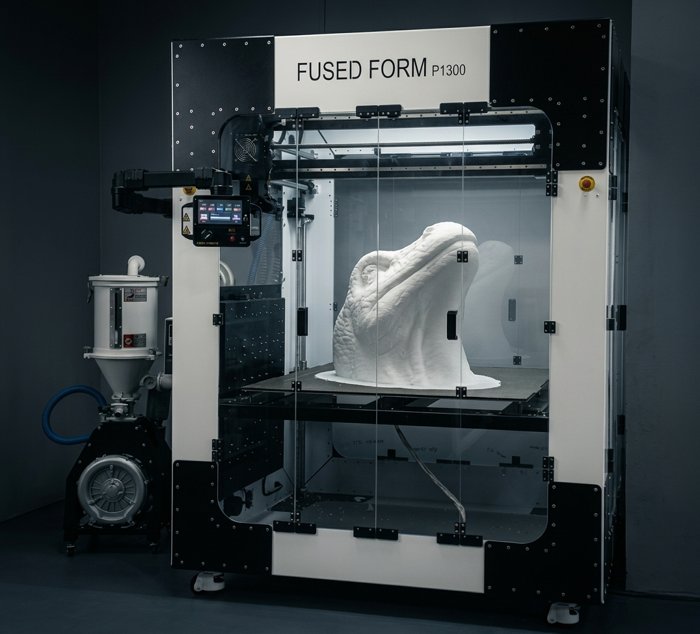
Thanks to pellet extrusion, the P1300 cuts print times and boosts productivity on large parts.
Monumental pieces for shows, installations, and unique experiences.
See examples →Everything you need to know about the P1300.
Its effective build volume is 110 × 110 × 130 cm, built for large-scale projects and industrial applications that demand truly large-format parts. For even larger parts, you can print them in sections and assemble them afterward — our team can advise you on partitioning and assembly software.
Working with pellets gives you access to a wide range of materials from the injection molding and extrusion industry, which you can buy directly from a supplier in your own country. The P1300 is an open-material printer: you can use any material within the machine's temperature range, giving you access to engineering-grade materials at raw-material prices, far lower than filament.
The material flow a pellet printer deposits is much higher, making it up to 45 times faster. While a filament printer takes about 15 hours to deposit 1 kg of material, the P1300 does it in about 3 hours — letting you produce large parts in much less time.
This technology is more complex than filament, due to the number of additional variables you need to account for when printing. That's why every machine includes 1-on-1 support from our team, to guide you and help you get the most out of your printer from day one.
Maintenance is very simple and you can do it yourself. If you're in another country, we ship you the parts you need along with our instructions, so you can make the replacement yourself without relying on a local technician.
There are a few important conditions to keep in mind. The space must be free of airborne oils or dust that could compact, since the machine has bearings that need to move freely. It should also have good ventilation and a fume extraction duct, a firm, level floor that can support the machine's weight, and stable electrical power to avoid damaging the electronic components. For more questions about your specific space, contact us.
Yes. We support you through installation and initial training, and you have ongoing technical support — always with 1-on-1 attention directly from our team. Reach out to learn the details for your location.
Tell us what you want to build and we'll help you define the best solution to make it happen.